- $37 an Hour is How Much a Year?
- Introduction to Hourly Wage Calculation
- Calculating $37 an Hour Annually
- Factors Influencing Annual Salary
- Understanding Gross vs. Net Income
- Comparison with Other Hourly Wages
- Managing Finances on $37 an Hour
- High-Demand Jobs Paying $37 an Hour
- Optimizing Earnings and Career Growth
- FAQs: $37 an Hour Annual Salary
$37 an Hour is How Much a Year?
Understanding how much $37 an hour translates to annually can significantly impact financial planning and lifestyle choices. Whether you’re an employee, freelancer, or entrepreneur, knowing the yearly equivalent can help you make informed decisions. This article covers varied aspects of this earnings level and discusses alternate queries surrounding it.
Introduction to Hourly Wage Calculation
The calculation of yearly earnings from an hourly wage is straightforward but can vary based on the number of working hours and other factors. An hourly wage of $37, when computed for a standard full-time schedule, can yield a fairly substantial yearly income. In this article, we will delve into the details of this calculation, potential variations, and related considerations.
Calculating $37 an Hour Annually
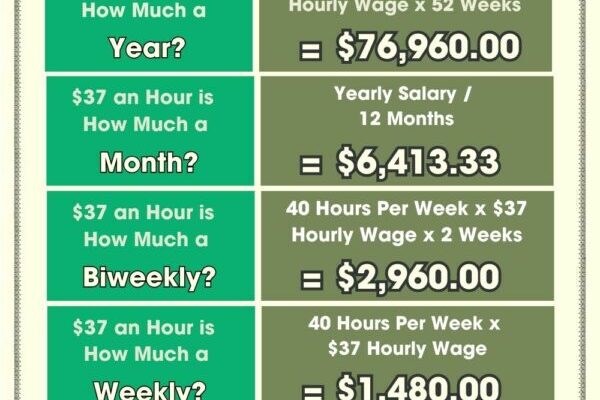
To calculate yearly earnings from an hourly wage, the standard formula is:
- Hourly Wage × Hours per Week × Weeks per Year
Assuming a typical full-time work schedule of 40 hours per week and 52 working weeks per year, the calculation would be:
- $37 × 40 × 52 = $76,960 per year
Factors Influencing Annual Salary
Several factors can influence the annual salary derived from an hourly wage:
- Overtime: Additional income from working beyond typical hours.
- Time Off: Vacations or unpaid leave can lower total annual earnings.
- Part-time Work: Working fewer hours weekly than full time reduces annual income.
- Bonuses: Sometimes included in annual earnings but vary by industry and role.
Understanding Gross vs. Net Income
While $76,960 represents the gross income, net income accounts for deductions such as taxes, social security, and health insurance. These deductions can significantly affect take-home pay, necessitating personalized calculations.
Comparison with Other Hourly Wages
| Hourly Wage | Annual Salary (40 hours/week) |
|---|---|
| $15 | $31,200 |
| $25 | $52,000 |
| $37 | $76,960 |
| $50 | $104,000 |
Managing Finances on $37 an Hour
Earning $37 an hour can facilitate a comfortable lifestyle, but effective financial management is key. Budgeting, planning for taxes, and saving are essential practices. Here’s a quick guide:
- Establish a budget: Track income and expenses.
- Plan savings: Set aside a portion for emergencies and retirement.
- Reduce debts: Prioritize loan and credit card payments.
High-Demand Jobs Paying $37 an Hour
Several industries offer positions paying $37 an hour, particularly in specialized or technical fields. Here are some examples:
- Healthcare Professionals
- Information Technology Specialists
- Skilled Trades and Technicians
- Engineering and Construction Roles
Optimizing Earnings and Career Growth
Pursuing additional qualifications and making strategic career moves can enhance earnings potential. Consider the following:
- Further education or certifications: Invest in skills that increase marketability.
- Networking: Connectivity can lead to opportunities.
- Industry conferences: Stay abreast of industry trends and innovations.
FAQs: $37 an Hour Annual Salary
-
How much is $37 an hour annually?
The yearly salary would be approximately $76,960, assuming a full-time schedule of 40 hours a week for 52 weeks.
-
Is $37 an hour considered a good wage?
Yes, $37 an hour is generally considered a well-compensated wage in many professions and regions.
-
What jobs typically pay $37 an hour?
Roles in healthcare, IT, skilled trades, and engineering often offer hourly pay rates around $37, depending on experience and location.
-
How does location affect a $37 hourly wage?
Cost of living and local market conditions can impact the purchasing power and perception of a $37 hourly wage.
-
Can $37 an hour support a family?
This can vary based on family size, location, and financial obligations, though it affords a good standard of living in numerous cases.